


Decoding the Earth’s Ancient Secrets: A Journey into the World of Palaeosciences
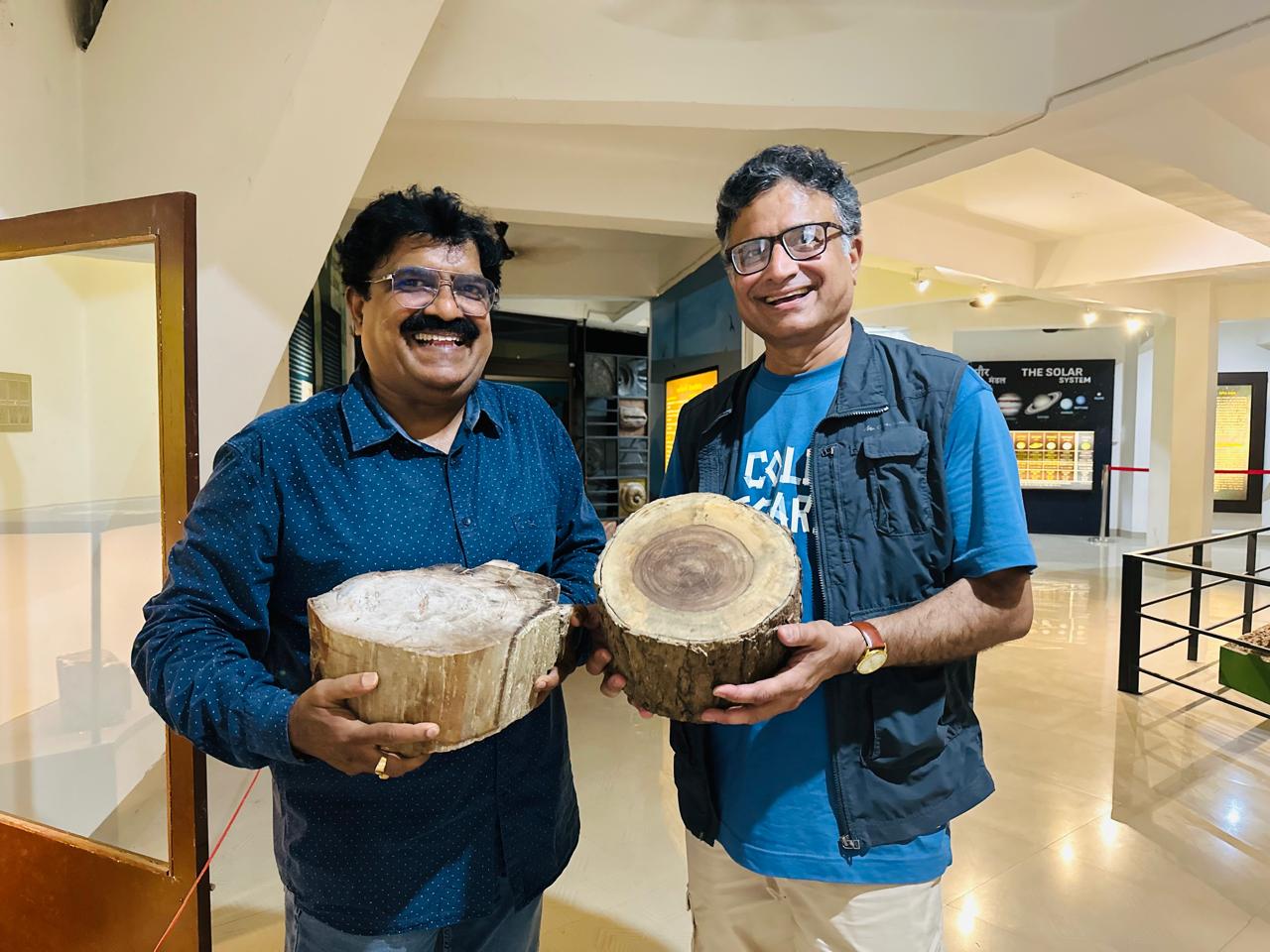
In an exclusive interview, Prof. Mahesh G. Thakkar, Director, BSIP, shared key insights and perspectives with Dr Nimish Kapoor, SCoPE Desk, BSIP
Have you ever wondered what stories lie buried beneath our feet, etched in layers of rocks and sediments? These stories—thousands and millions of years old—hold the key to understanding the Earth’s dynamic history. In a captivating conversation, Prof. Mahesh G. Thakkar, Director of the Birbal Sahni Institute of Palaeosciences (BSIP), invites us to explore the fascinating world of palaeosciences and the vital role it plays in unearthing the past to shape our future.
A Gateway to Deep Time: The Vision of BSIP
In an era defined by rapid environmental shifts and technological breakthroughs, there exists a growing necessity to look deep into Earth’s geological past to understand its trends in the present and future. The Birbal Sahni Institute of Palaeosciences (BSIP), under the leadership of its Director, Prof. Mahesh G. Thakkar, is emerging as a national hub that not only explores the fossilized history of life but also links ancient clues with modern-day scientific challenges.
“BSIP is a unique institution where deep-time knowledge meets modern science,” says Prof. Thakkar. “It is here that fossils, sediments, and isotopic records tell us stories that have immense relevance to today’s environmental and societal issues.”
With a legacy dating back more than eight decades, BSIP has been a pioneering force in palaeobotany and Earth system sciences. Its multidisciplinary research spans palaeontology, palynology, geochronology, sedimentology, stratigraphy, isotope and organic geochemistry—positioning it as an institution that contributes significantly to both foundational science and policy-relevant knowledge.
BSIP, located in Lucknow, stands as a premier institution in palaeosciences in India. “We are committed to interdisciplinary research in geology, palaeobotany, palynology, micro to mega palaeontology, Geochemistry, Geochronology, Ancient DNA, Archaeobotany and climate science,” says Prof. Thakkar. BSIP’s work is instrumental in understanding changes in the Earth's climate, assisting archaeological discoveries, and even guiding oil and gas exploration.
One of BSIP’s key strengths is its state-of-the-art laboratories and scientific infrastructure, enabling cutting-edge research in palaeoclimate reconstruction and dating techniques like radiocarbon, OSL and stable isotope analysis.
Why Should We Care About the Distant Past?
According to Prof. Thakkar, “Studying past life through fossils is essential for understanding the history of life on Earth, the processes of evolution, and the impacts of climate and environmental changes over geological time. Fossils serve as history books, revealing how organisms adapted or went extinct, helping us trace the roots of present-day biodiversity. This knowledge not only deepens our understanding of natural history but also offers valuable insights into present and future ecological challenges, including climate change and species conservation.” It also helps us understand how Earth responds to natural and human-induced changes.
What is Palaeoscience?
“Palaeoscience is the science of understanding Earth's ancient past,” explains Prof. Thakkar. “It helps us reconstruct the environments, climates, and life forms that existed millions of years ago.” From fossilized plants and pollen to microfossils and isotopic signatures, palaeoscientists study a wide range of indicators preserved in sediments, rocks, and geological formations. These remnants serve as time capsules, helping scientists’ piece together Earth’s history, including the evolution of ecosystems, natural disasters, and climatic shifts.
Why Study Geology and Palaeosciences?
Responding to the common perception that geology is only about rocks, Prof. Thakkar clarifies: “Geology is the story of Earth. And palaeosciences tell us how life, climate, and continents evolved through time.”
“We use microscopic pollen grains to reconstruct the Indian monsoon over thousands of years, and stable isotopes to understand ancient sea-level changes. It’s not just about the stones—it’s about the stories.”
He points out that job prospects in this field are growing across sectors—from environmental consulting to mineral exploration, petroleum geology to climate modelling. “You can contribute to energy security, hazard mitigation, archaeological studies, and even astrobiology. It’s a vast and growing field.”
Prof. Thakkar also emphasizes the interdisciplinary nature of palaeosciences. “Today’s geoscientist works with satellite data, GIS software, chemical instruments, and even machine learning models. BSIP trains young minds to think across disciplines,” he says.
The Urgent Relevance of Palaeosciences Today
Prof. Thakkar strongly believes that palaeosciences are no longer confined to academic boundaries—they have become central to confronting global issues like climate change, biodiversity loss, and natural hazards. “We are living in the Anthropocene. It is critical to understand how the Earth responded to past climate shifts, sea-level changes, and mass extinctions. These records are embedded in rocks, fossils, pollen, and isotopic data—and this is what we study,” he explains.
At BSIP, research is aligned with national priorities such as groundwater sustainability, coastal vulnerability, fossil fuel exploration, and archaeological dating. “We are actively working with Geological Survey of India, oil companies like ONGC, OIL, space agencies, and environmental institutions. Our research helps identify resources, understand hazards, and reconstruct ancient environments that inform present-day planning,” he adds.
Inspiring the Next Generation of Earth Scientists
At the core of Prof. Thakkar’s message lies a heartfelt call to students, research scholars, and aspiring young scientists. “India urgently needs more geoscientists,” he emphasizes. “Beneath our feet lies an entire world waiting to be discovered. If you are fascinated by Earth’s history, committed to safeguarding its future, and inspired by scientific inquiry, then the palaeosciences are your path forward.” BSIP provides a rich ecosystem for learning and discovery. With state-of-the-art laboratories, a highly experienced faculty, and collaborative projects with institutions across the country and abroad, it offers aspiring researchers a chance to contribute to globally significant studies.
“We offer research fellowships, project-based training, and access to some of the most unique fossil and sedimentary archives in the world,” he says. “This is a field where your work in the laboratory or in the field can influence national mineral, water and environmental policies, heritage conservation, or even planetary climate models.”
A significant part of BSIP’s mission is to engage the public and nurture curiosity among young minds. “We are increasingly focusing on outreach, education, and digital communication,” says Prof. Thakkar. The institute is working to make palaeosciences more accessible through exhibitions, student programs, and now, through the newly launched BSIP Blog.
This blog, Prof. Thakkar hopes, will serve as a digital bridge between scientists and society—translating complex research into stories that everyone can connect with. “We want to ignite the same sense of wonder in others that we feel every day at the institute.”
Connecting Science with Society
One of the defining missions of BSIP under Prof. Thakkar’s leadership is bridging the gap between science and society. “Scientific research should not remain confined to publications. We must reach the people—through museums, exhibitions, lectures, digital media, and school outreach,” he stresses.
BSIP has been actively engaging with the public through science festivals, school science camps, environmental awareness drives, and exhibitions on topics like ancient flora, Gondwana ecosystems, and the fossil heritage of India. The institute also conducts training programs and workshops under national missions like Mission Karmayogi and Swachh Bharat Mission, empowering scientists, scholars, and officers in scientific social responsibility and science communication at the grassroots level.
“Through these initiatives, we want to make palaeosciences accessible, exciting, and empowering—especially for students and the youth. Our goal is to build a scientific culture where everyone is curious about Earth’s story,” says Prof. Thakkar.
From Fossils to Futures: A National Role
BSIP’s contributions go far beyond academia. The institute plays a strategic role in national development, offering expertise in dating cultural and archaeological sites, identifying palaeochannels for groundwater conservation, aiding in oil and coal exploration, and providing palaeoclimatic data to support policy decisions.
Prof. Thakkar reflects on the importance of these roles: “We help determine the age of Harappan sites, track ancient river systems, and even aid in understanding historical tsunamis. This work is not only scientifically significant but also culturally and economically vital for India.”
Pioneering Research in Geology for Disaster Resilience and Development
Prof. Thakkar brings a wealth of experience from his extensive research in Quaternary geology, palaeoseismology, palaeoclimates and coastal dynamics—fields with direct implications for India's development and disaster preparedness.
One of his landmark studies on palaeoseismicity in the Kachchh region has provided vital insights into the recurrence intervals of major earthquakes. His work helped identify palaeo-liquefaction features and fault line activity around the Katrol Hill Fault, South Wagad Fault, Island Belt Fault, Kachchh Mainland Fault and Allah Bund Fault—information that is critical for seismic zoning and urban planning in western India.
In the domain of coastal geomorphology and climate change, Prof. Thakkar’s research along the Kachchh coastline has documented sea-level fluctuations over the Holocene period, contributing to models that predict coastal vulnerability in the face of rising seas. His findings, based on beach ridge sequences, Great Rann of Kachchh sediments with absolute dates, have been used by coastal planners and disaster management agencies.
Another significant contribution is his work on ancient river systems and palaeochannels in western India, especially in the Great Rann of Kachchh and the plains of Banni. His sedimentological and remote sensing studies have identified buried river courses and fossilized fluvial systems, offering clues for groundwater recharge zones and supporting water resource planning in arid and semi-arid regions.
“These findings are not just academic—they serve as inputs to infrastructure development, water management, and disaster mitigation,” says Prof. Thakkar. “Our past teaches us how the land has behaved under natural stress. That knowledge is essential for building a safer and more resilient India.”
Vision for the Future: A Hub of Excellence and Outreach
Looking ahead, Prof. Thakkar envisions BSIP as a global knowledge hub that nurtures curiosity-driven research while addressing pressing global challenges. He foresees a future where BSIP expands its collaborations, enhances its technological capabilities, and reaches out to a wider audience through digital platforms and public engagement.
“In the next decade, BSIP aims to be a centre of excellence not only in palaeosciences but also in climate science, natural hazard assessment, and science communication,” he shares.
A Message for Future Scientists
Prof. Thakkar extends an inspiring invitation to aspiring students and budding scientists: “Come with curiosity. Come with questions. At BSIP we are ready to guide you through the billion-year-old story written in the rocks beneath us. In exploring the earth’s ancient past you’ll be equipping yourself to solve the challenges of the future."
BSIP is a place for all Indians who seek a deeper understanding of our planet. We wholeheartedly welcome students, educators, policymakers, and curious minds to engage with us - visit, collaborate and learn together. This is not just a journey into the past; it’s a step toward building a more informed, resilient and sustainable future.”
Under Prof. Thakkar’s leadership, BSIP is charting a future that balances rigorous research with societal relevance. His vision is clear: to transform palaeosciences from a specialized academic pursuit into a vibrant field that connects India’s rich geological heritage with the needs of its present and future generations.