Centre for Geo-heritage and Geo-tourism Promotion (CPGG)
PREAMBLE
The collection of fossil plants made by Professor
Sahni from
India and abroad,
including those received by him as gift or in exchange, structured the beginning of
Institute’s
museum. The repository of the museum has continuously been enriched through collections made
by
scientists of the Institute during their fieldwork all over the country, and also by the
receipt in
exchange of material from foreign countries. The Holotype specimens, slides and figured
specimens are
systematically stored by the museum that is readily available for the investigation to the
research
workers.
Why is geoheritage at risk? There is scope of partial or total loss of
geological
sites triggered by urban development, vandalism, smuggling, absence of a proper legal
protection and
international agreements, lack of expertise, and unawareness of international, national and
local
authorities.
WHY DOES SOCIETY NEED GEOCONSERVATION ?
The implementation of
effective
geoconservation strategies brings great advantages to society. Firstly, it raises awareness
of the
need to understand natural systems and the geological component of ecosystem services.
Moreover,
well-managed geological sites can support different types of sustainable use with clear
benefits for
the society, such as scientific, educational and economic use. This is already happening in
many
territories around the world such as with Global Geoparks, which have been fully recognized
by UNESCO.
Geotourism and recreational activities based on geodiversity elements are completely
integrated in the
aims of the International Year of Sustainable Tourism, proclaimed by the United Nations for
2017.
Geological outcrops are the natural laboratory of geoscientists. Therefore, our basic interest is to preserve it as far as possible. These outcrops are like history book providing details of evolution of Earth through time. Further, there are several unique geological features of national and global significance that can be classified as Geoheritage sites. These Geoheritage sites are lessons of geological events and processes, which are not only of the interests of geoscientists but also for the common people and students. Like cultural and historical site, these Geosites provide information about the past events.
The United Nations 2030 Agenda for Sustainable Development defines 17 Sustainable Development Goals to be universally applied in all countries. Many of these goals will demand proper management of nature, including both geodiversity and biodiversity.
STATUS OF GEOHERITAGE IN INDIA
There are about 195 UNESCO
Global
Geoparks (UGGs) in 48 countries (by the year 2023) including some very small countries. BUT,
India do
not have even a single UGG while we have 40 UNESCO World Heritage Sites. This is because we
are still
lacking the knowledge about the concept of Geoheritage conservation and development of
Geoparks. We
also need to understand that Geoparks are not Geological Parks. Geoparks are amalgamation of
geological, cultural and historical heritage with geology in the centre. Involvement of
community is
the core aspect of every Geopark. Therefore, making government and developmental agencies
aware of
this concept is the need of time.
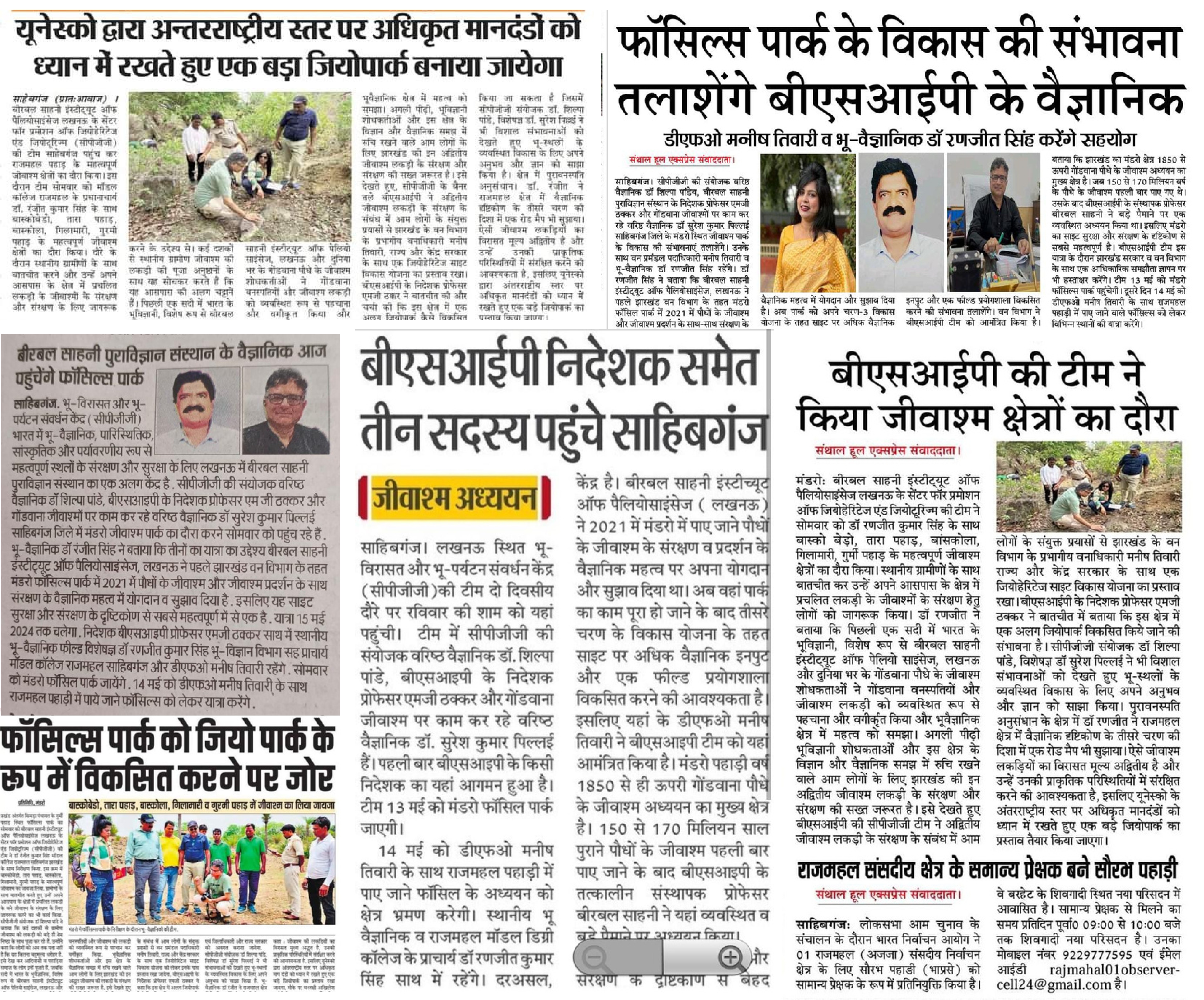
Further, there are several geoheritage development projects in different states and good work is being done, but there is no central thought about the development plan of any geoheritage site, no proper understanding about the concept and even it has been observed that development works has harmed the geoheritage sites due to lack of proper scientific support. After the declaration of Mawmluh Cave of Meghalayan Age fame among the First 100 IUGS Geoheritage Site, whose type specimen is in the museum of BSIP, the awareness about the conservation and geotourism potential of geoheritage sites have taken a momentum. BSIP has been instrumental in several geoheritage conservation projects and organised awareness drives in association with other organisations.
The sustainable approach of geoheritage conservation is the Geotourism. The Geoparks/sites should be developed in such a way that they are self-sustainable with least dependency on funding agencies. Further, PPP model needs to be implemented in the promotion of Geotourism. However, there is no centre or agency to advice/support developmental agencies/state governments in planning, development and establishment of Geoheritage sites or Geoparks in India. As such, isolated efforts are not bearing required fruits. There is no networking, cooperation and understanding between various agencies due to lack of a platform for interaction. Therefore, it is need of the time to establish the CENTRE FOR PROMOTION OF GEOHERITAGE & GEOTOURISM(CPGG) under the ambit of BSIP, Lucknow with available expertise.
ROLE OF CPGG:
- Take selective in-house projects of geoheritage sites to prepare developmental proposals to submit to State Governments.
- Take up consultancy projects of State Governments and developmental agencies to prepare dossiers, plans, and provide time-to-time guidance for any Geoheritage site plan.
- Prepare a national dossier of Geoheritage sites, including:
- Popular printed and soft copies of brochures
- Short promotional films
- Delivering lectures to young students and professionals
- Work as a nodal agency for inter-departmental interactions and mutual cooperation among various developmental agencies.
- Prepare a platform for interdisciplinary interactions by:
- Organizing training courses
- Hosting conferences
- Building networking opportunities
- Provide R&D scope for Ph.D. scholars from geology, geography, and tourism sectors.
For further enquiries please contact:
Birbal Sahni Institute of Palaeosciences,
53, University Road, Lucknow - 226007, Uttar Pradesh, India
Website: www.bsip.res.in
Email: geoheritage@bsip.res.in, director@bsip.res.in
Phone: +91-7607374176, +91-522-2742901
ACTIVITIES AND EVENTS
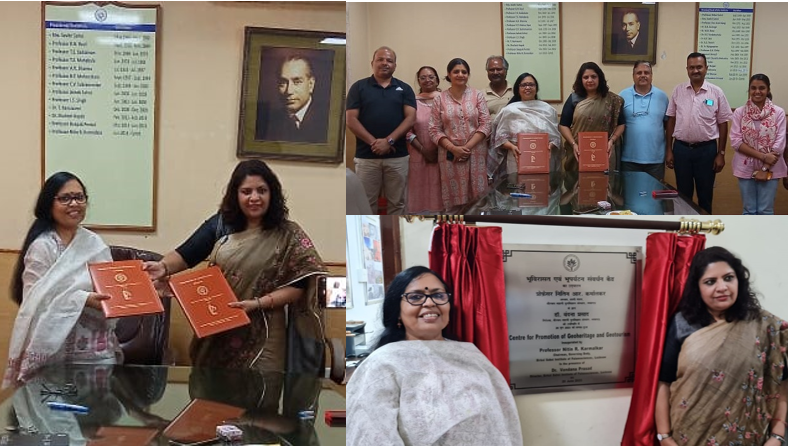
BSIP signed MoU with MPEDB
Birbal Sahni Institute of Palaeosciences, Lucknow and Madhya Pradesh Ecotourism Development
Board
(MPEDB) signed a Memorandum of Understanding (MoU) on 25th July, 2023 to have mutual
cooperation for
conserving and promoting the geoheritage and geotourism. Dr. Sameeta Rajora, CEO, MPETDB,
Bhopal
visited BSIP, Lucknow to sign the MoU and discussed plans with Dr. Vandana Prasad, Director,
BSIP.
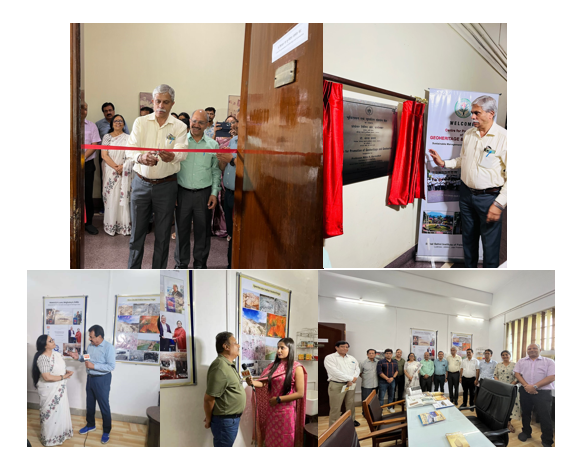
Inauguration of CPGG
Newly established Center for promotion of Geoheritage and Geotourism was inaugurated by Prof. Nitin R Karmalkar, Chairman, Governing Body, Birbal Sahni Institute of Palaeosciences, Lucknow in presence of Dr. Vandana Prasad, Director, Birbal Sahni Institute of Palaeosciences, Lucknow on 28 June 2023. The Governing Body and Research Advisory Committee members and senior scientists were present during the ceremony.